Allow us to make a prediction.
In five years, the major music companies will not only be scouring the web for AI infringement, they will also be issuing legal letters directly to the perpetrators…
Sound far-fetched? It isn’t. It’s sitting inside a pair of patent applications published by the US Patent and Trademark Office on February 12, 2026.
MBW unearthed the filings while researching our recent story on the patent portfolio being built by Music IP Holdings, the entity formed last year through Universal Music Group‘s partnership with IP asset management firm Liquidax Capital.
That earlier story reviewed three filings in the portfolio covering multi-stage approval and controlled distribution of AI-generated derivative works. Nashville-headquartered MIH has said it holds “more than 60 protected innovations with numerous additional technology families and portfolios under development.”
The two filings we’re looking at here are part of that broader portfolio.
Titled “Media Rights Platform Systems and Methods” and bearing publication numbers US 20260044581 A1 and 20260044583 A1, they list Music IP Holdings as sole applicant and Daniel Drolet, Liquidax’s founder and MIH’s Chairman and CEO, as sole inventor. That is a different pattern from the derivative works filings covered in our earlier piece, which include UMG staffers Chris Horton, Jeremy Uzan, and Sion Elliott among the co-inventors.
Both filings were lodged with the USPTO on October 16, 2025. As with the earlier derivative-works filings, neither MIH nor UMG has publicly disclosed whether or when they intend to deploy or license the technology described, or to whom.
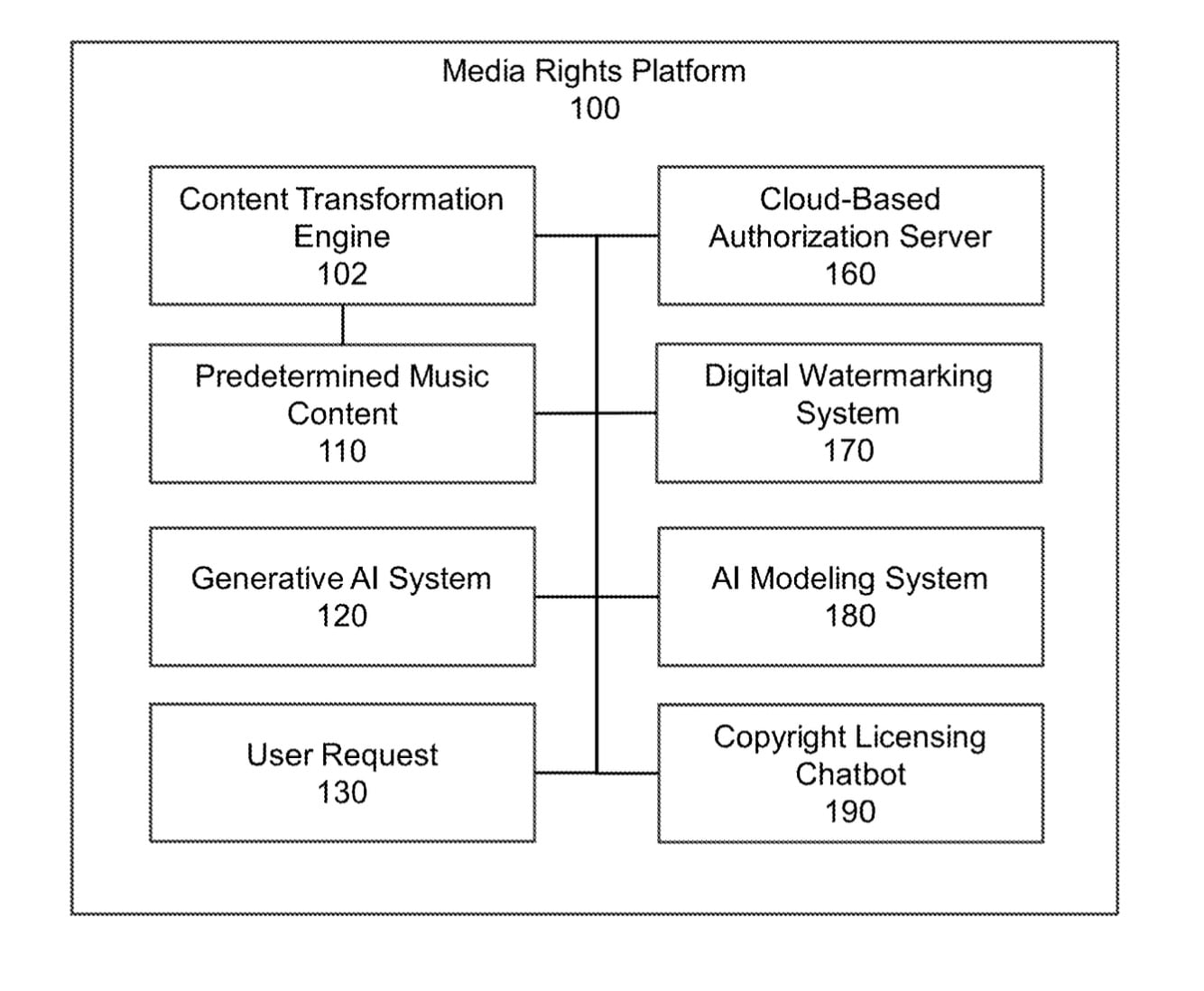
What the filings describe is a sprawling end-to-end “media rights platform” that sits between rightsholders, generative AI systems, and the end users who want to prompt AI to create derivative works from copyrighted music. But it’s the enforcement machinery bolted onto the platform that should make AI firms take notice.
Four components of the filings stand out, plus a fifth that borrows from a playbook the live concert ticketing business already knows well.
1. A licensing chatbot that plugs directly into ChatGPT, Claude and others
At the heart of the filings is a system called the “Copyright Licensing Chatbot” (referred to in the patents as component 190), described as an “agent” or “plugin” that plugs directly into existing large language model platforms – the filings explicitly name-check ChatGPT and Bard, but also reference Anthropic’s Claude 2, Google‘s LaMDA and PaLM, Hugging Face’s BLOOM, Nvidia’s NeMo, XLNet, Cohere and others.
The bot is designed to interrogate potential licensees about commercial vs. non-commercial use, timeframe, and geographical scope before either clearing or escalating the request.
The filings state that the chatbot “questions the potential licensee on a number of usage attributes to identify both the appropriate licensing models and to confirm that the proposed usage of the content is aligned with the artist’s principles and overall requirements that need to be met before their material shall be licensed and used in a derivative work.”
Risk profiling is handled by machine learning models trained on historical licensing data and infringement patterns. Low-risk, non-commercial queries can be cleared in-conversation. High-risk requests get escalated to humans.
2. An AI crawler that hunts infringement – and sends its own cease-and-desists
This is the piece that might matter most for MBW readers.
The filings describe what they call an “LLM Agent Copyright Crawler” – a system that “works across the Internet and interacts with Copyrighted Derivative Content created by Users of LLM’s”.
The filings describe the crawler as sampling content streams from the open web, detecting digital watermarks embedded in images and audio using machine learning, and cross-referencing that material against IP licenses “currently in force”.
The filings are explicit about what the agent does when it finds a mis-match.
The filings state that the “LLM Agent” can connect directly with a source of materials and “propose licensing terms”; it can thank users for having “properly licensed usage”; and – critically – it can send “one or more cease and desist letters to user or streamer”. It can also flag the usage for “human legal intervention”.
That is, functionally, a blueprint for agentic copyright enforcement. A bot that, as described in the filings, would find infringement, assess risk, and issue legal correspondence, with human lawyers involved only as an escalation tier.
3. An AI model of the rightsholder that predicts whether they’d say yes
The platform also includes an AI Modeling System (component 180) that models the copyright owner themselves, using machine learning trained on “historical licensing decisions, legal precedents, and copyright holder behavior patterns”.
The purpose: to predict, before a derivative work is ever created, whether the rightsholder would approve it.
The filings describe the system as “approving creation of the derivative work in response to the modeling predicting that the owner would approve the request.” Derivative work creation is then approved or declined on the basis of that prediction.
4. Digital watermarking and fingerprinting to trace every AI-generated track
Underpinning the whole system as described is a Digital Watermarking System (component 170) using spread spectrum, quantization-based, transform domain, and perceptual watermarking techniques.
Paired with it is a “digital fingerprinting engine” designed to detect the signatures of specific generative AI models – what the filings call “GAI-MC” fingerprints, described as “unique byte sequences generated by specific AI model architectures”.
The filings describe the system as identifying “which LLM and music aligned software created the copyright derivatives in order to identify how many derivatives were created, how much money is owed, how much value was used to train the LLMs in order to create the derivatives.”
5. A dynamic pricing engine for AI music licenses
Perhaps most intriguingly, the filings describe a dynamic pricing engine that adjusts licensing costs in real time “based on demand, seasonality and market conditions” using reinforcement learning techniques to continuously optimize pricing based on “conversion rates, customer lifetime value, and market penetration goals”.
The system is designed to model price elasticity of demand, analyze competitor pricing, and define “dynamic pricing rules and algorithms that adjust prices in real-time based on demand signals, inventory levels, competitor pricing, and customer segmentation”.
The filings even contemplate the system “dynamically adjusting approval criteria based on market factors, demand patterns, and seasonality,” meaning not just the price of a license could flex in real time, but whether a license is granted at all.
The filings suggest this would be paired with personalized subscription plans, bundle offerings, loyalty rewards, and tiered pricing for AI music licensees – a model that, to MBW’s eye, at least, looks a lot less like traditional music licensing and a lot more like the demand-based dynamic pricing already familiar from the live concert ticketing business, applied to copyright permissions.
The documents aren’t products. They’re patent applications. They may never ship in the form described, and patent claims often stretch wider than what gets built. As with the rest of MIH’s portfolio, UMG and MIH have not publicly disclosed their commercial plans for the technology.
But the filings tell us something about where UMG and its patent-licensing partner believe the industry is heading, and the level of automation they are preparing to claim IP rights over.
For AI firms already fighting lawsuits from major labels, the direction of travel is clear enough. Today, the cease-and-desist letter is drafted by a lawyer at Latham & Watkins or King & Spalding. Tomorrow, on this blueprint, it could be drafted and sent by a bot.
Five years, we said. We’ll check back.Music Business Worldwide
#major #labels #overcome #copyright #threat #music #turning #powerful #weapon
About the Author